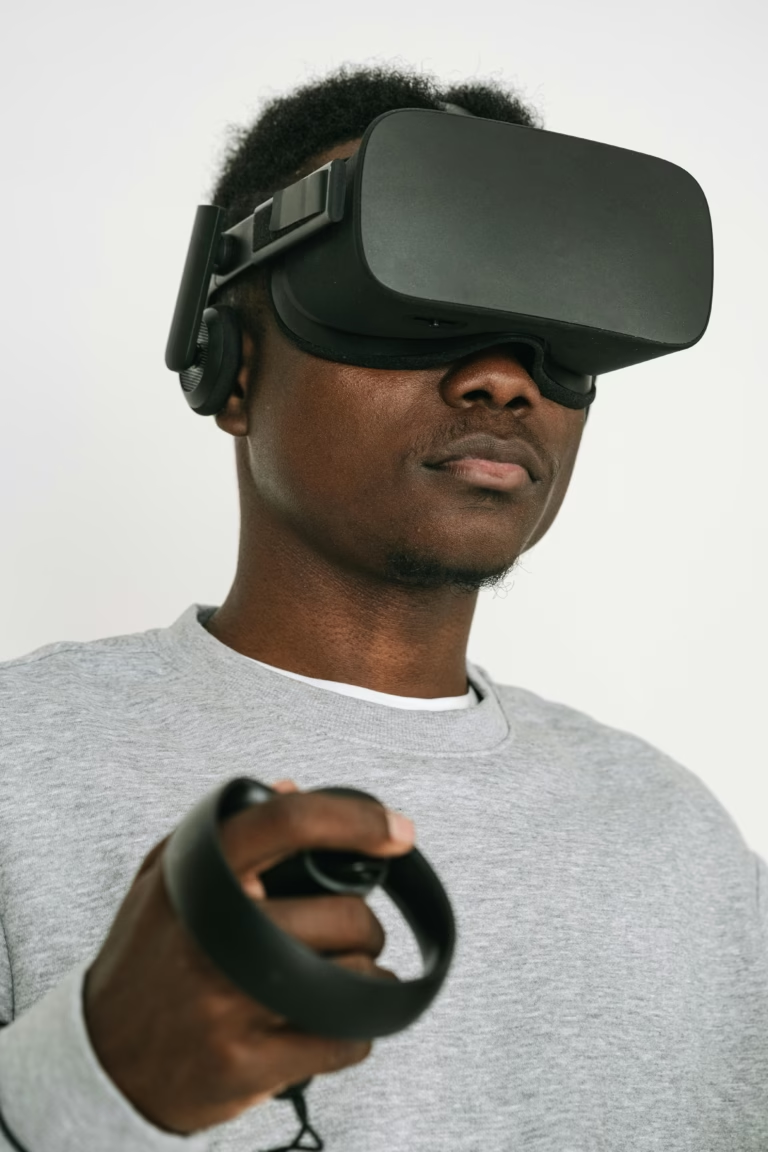
The Ultimate Guide to Smart Glasses in 2025: AR, AI, and Beyond
Introduction: More Than Just Vision Correction
Imagine walking through a foreign city where directions appear to float on the street in front of you, or instantly translating a restaurant menu just by looking at it. Envision having a massive, private cinema screen available wherever you go, or receiving real-time information about the world simply by asking. This is no longer the stuff of science fiction; it is the rapidly evolving reality of smart glasses. Once a niche and often clunky technology, smart glasses have exploded into the consumer market, becoming one of the most exciting frontiers in wearable technology. By 2025, they have shed their awkward prototypes to become stylish, functional, and powerful devices that blend digital information seamlessly with our physical world. From augmented reality glasses that overlay digital content onto your surroundings to AI-powered assistants that see what you see, smart glasses are poised to redefine how we interact with technology. This comprehensive guide will delve into the cutting-edge world of smart glasses technology, exploring the top models available today, the groundbreaking developments from giants like Apple and Google, and how these devices are not only changing entertainment and work but also profoundly impacting lives, for instance, through specialized smart glasses for the blind.
Defining the Categories: From Audio to Full Augmented Reality
The term “smart glasses” encompasses a spectrum of devices with varying capabilities. Understanding these categories is key to identifying which type suits your needs.
Audio, AI, and Camera Glasses: These are the most accessible and consumer-friendly smart glasses on the market today. Think of them as sophisticated headphones and a hands-free camera built into a stylish frame. Their primary functions include playing music via open-ear speakers, taking calls, using a voice assistant (like Meta AI or Alexa), and capturing photos and videos from a first-person perspective. They connect wirelessly to your smartphone and prioritize discretion and style. Prime examples include the Meta Ray-Ban smart glasses and the Amazon Echo Frames . The recently unveiled Oakley Meta HSTN also falls into this social-media-focused category .
Augmented Reality (AR) & Display Glasses: This category represents the more advanced end of the spectrum, focusing on visual immersion. These augmented reality glasses project digital information and images onto the lenses, creating the illusion that screens and objects exist in your real world. Some are “AR-lite,” primarily acting as a portable, giant display for your laptop, gaming console, or phone. Others are more advanced, using cameras and sensors to understand your environment and anchor digital objects within it. Devices like the XReal One Pro and Rokid AR glasses are leading this charge, offering a breathtaking portable theater experience .
The Current Market Leaders: A Detailed Look at Top Smart Glasses
The market in 2025 is vibrant and competitive, with several standout products defining the user experience.
Meta Ray-Ban Smart Glasses (and the New 2025 Collection)
Meta, in partnership with EssilorLuxottica (the parent company of Ray-Ban), has been instrumental in bringing smart glasses to the mainstream. The original Ray-Ban Meta glasses succeeded by embedding impressive technology into iconic Wayfarer and Headliner frames, creating a device people actually want to wear. Their core strengths are a high-quality camera for first-person photo and video capture and excellent open-ear audio for music and calls .
In 2025, Meta has expanded its lineup significantly, announcing four new models: the next-generation Ray-Ban Meta Gen 2, the athlete-focused Oakley Meta Vanguard, the everyday Oakley Meta HSTN, and the innovative Ray-Ban Meta Display glasses, which finally incorporate a small heads-up display . This massive investment signals Meta’s strong belief in the future of your face as a platform for augmented reality glasses and AI.
XREAL (formerly Nreal) Air 2 Ultra & XReal One Pro
If you’re looking for the pinnacle of consumer AR glasses technology, XREAL is a brand to watch. The XReal One Pro is currently hailed as “the most high-tech pair of video-focused AR glasses” on the market, boasting a massive 57-degree field of view that makes the virtual screen feel truly immersive. It includes built-in head-tracking to keep the screen locked in space, a feature that sets it apart from many competitors .
For developers and early adopters seeking “proper” AR, the Xreal Air 2 Ultra offers a glimpse into the future of spatial computing. It doesn’t just create a floating screen; it can understand and interact with your environment, similar to the promise of high-end headsets but in a more accessible form factor .
Rokid Max 2 and Ecosystem
Rokid AR glasses are another heavyweight in the display-focused category. The Rokid Max 2 is praised for its sharp picture and a wide 50-degree field of view. A key feature for nearsighted users is the built-in focus dials, which can correct vision up to -6.0 diopters, eliminating the need for custom prescription inserts in many cases . Rokid often bundles its glasses with the Rokid Station, a handheld Android TV device, creating a complete portable entertainment system dubbed the “AR Joy 2” that can simulate a screen over 200 inches .
Vuzix Blade 2 for Enterprise
While consumer models get most of the attention, enterprise-focused smart glasses are driving innovation in the workplace. The Vuzix Blade 2 is a prime example. These smart glasses feature a full-color display, an autofocus HD camera, and integrated speakers and microphones. They are designed for hands-free remote expert support, teleconferencing, and workflow guidance, allowing field technicians to stream what they see to a remote colleague and receive visual instructions in their line of sight . Priced at $799.99, they represent the professional side of smart glasses technology .
Accessibility Breakthrough: Envision AI Glasses for the Blind
Perhaps the most profound application of this technology is in the accessibility space. The Envision Glasses are built on the Google Glass Enterprise Edition 2 platform and are designed specifically for people who are blind or have low vision. Using the built-in camera, these glasses can read any text aloud—from product labels and mail to handwritten notes—in over 60 languages. They can also describe scenes, identify colors, detect light, recognize faces, and even recognize currency. With features like “Ask Envision” powered by GPT-4, users can scan documents and ask complex questions about their content. This is a powerful example of how AI glasses for the blind can foster independence and accessibility .
For more deep dives on how AI is transforming technology, explore the insights at buzner.site.
The Future is Here: Google, Apple, and Samsung’s Roadmaps
The next two years promise a seismic shift in the smart glasses landscape, as the world’s largest tech companies formally enter the arena.
Google’s Android XR and Strategic Partnerships
After the learned lessons of Google Glass, Google is taking a more collaborative and software-focused approach with Android XR. This new platform is built for the Gemini era and is designed to power a whole ecosystem of headsets and glasses . Google’s vision is an AI assistant that shares your vantage point, offering hands-free help.
At Google I/O 2025, the company demonstrated prototypes of Android XR glasses that could provide live translation, turn-by-turn directions projected onto the ground, and the ability to ask Gemini questions about what you’re looking at . Crucially, Google is partnering with established eyewear brands Gentle Monster and Warby Parker to create stylish glasses that people will want to wear all day, acknowledging that design is just as important as technology .
Apple’s Long-Awaited Entry
While Apple has remained silent publicly, renowned analyst Ming-Chi Kuo has outlined a detailed roadmap for Apple smart glasses. Apple is reportedly developing multiple head-mounted devices, including three Vision series products and four smart glasses variants .
The most anticipated near-term product is a “Ray-Ban-like” model without a display, scheduled for mass production in Q2 2027. This device would focus on audio playback, camera functions, and AI environmental sensing, potentially shipping 3-5 million units and pushing the entire category into the mainstream . This would be followed by more advanced Apple AR glasses with displays in late 2028. Apple’s entry is expected to be a watershed moment, validating the market and accelerating adoption across the industry.
Samsung’s Project “Haean”
Not to be left behind, Samsung is also preparing its own entry. Reports suggest the company has a smart glasses project internally known as “Haean” that could launch in 2025. The initial model is expected to be a display-less pair, similar to the Meta Ray-Bans, using camera and sensor-based gesture control . This aligns with the industry trend of starting with familiar form factors before introducing more complex display technology.
A Buyer’s Guide: Choosing the Right Smart Glasses for You
With so many options, selecting the right pair can be daunting. Here are the key factors to consider, aligned with the smart glasses price and feature spectrum.
Key Considerations Before You Buy
Purpose: This is the most important question. Do you want hands-free audio and a camera for social media? Look at the Meta Ray-Ban line. Do you crave a giant private screen for movies and gaming? AR glasses from XREAL or Rokid are your best bet. Do you need enterprise tools for work? Consider Vuzix.
Display vs. Audio: Do you need visual information overlays, or is audio interaction sufficient? This choice fundamentally separates the two main categories of devices.
Vision Correction: If you require prescription lenses, check the manufacturer’s options. Some brands like Rokid offer focus dials, while others, like XREAL, require you to purchase separate magnetic prescription lens inserts .
Battery Life: Audio-focused glasses like the Ray-Ban Meta offer several hours of use. Display-focused AR glasses are often tethered to a power source or a separate battery pack. Check the specs for your use case.
Style and Comfort: Since you’ll be wearing them on your face, aesthetics and fit are paramount. Brands like Meta and the upcoming Google partners have a clear advantage here with their fashion-industry collaborations.
Price Spectrum and Value
The smart glasses price varies dramatically based on capability.
Budget (Under $300): The RayNeo Air 3s Pro at $299 offers an excellent entry into AR display glasses, though it lacks some high-end features .
Mid-Range ($300 – $500): This is the sweet spot for audio glasses and entry-level AR. The Meta Ray-Ban glasses and Oakley Meta HSTN sit here, as does the Rokid Max 2 .
High-End ($500+): Flagship AR glasses like the XReal One Pro ($649) and professional tools like the Vuzix Blade 2 ($799) occupy this tier, offering the best performance and features for enthusiasts and enterprises .
To stay updated on the latest tech trends and deals, check out the curated lists on cybernov.site.
Conclusion: The Invisible Computer on Your Face
The journey of smart glasses from a futuristic concept to a tangible, stylish, and useful accessory has reached a critical inflection point in 2025. We are moving beyond the novelty factor and into an era of genuine utility. The convergence of powerful AI, sophisticated display technology, and partnerships with fashion giants is creating a new product category that promises to make computing more contextual, personal, and unobtrusive.
Whether it’s through the social connectivity of the Meta Ray-Bans, the immersive entertainment of Rokid AR glasses, the professional empowerment of the Vuzix Blade 2, or the life-changing accessibility of the Envision Glasses, this technology is finding its purpose. With Google, Apple, and Samsung poised to launch their own visions in the coming years, the competition will only fuel faster innovation and more compelling products. The future of technology is not in your pocket; it’s right in front of your eyes. The era of the invisible computer on your face has truly begun.